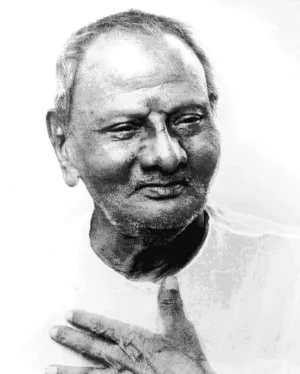
Biography
Nisargadatta Maharaj was an Indian spiritual teacher who lived and taught in the bustling city of Mumbai. A simple shopkeeper who sold bidis (Indian cigarettes), he received initiation from his guru Sri Siddharameshwar Maharaj and attained realization within three years of dedicated practice.
Unlike many teachers who withdrew from worldly life, Nisargadatta continued running his small shop while receiving seekers in his modest apartment. His teachings were recorded in the book "I Am That," which has become one of the most influential spiritual texts of the modern era, introducing countless Western seekers to non-dual wisdom.
His teaching style was direct and uncompromising, often challenging students' assumptions and pointing relentlessly to that which exists prior to consciousness itself. He emphasized the importance of staying with the sense "I Am" as the gateway to recognizing one's true nature beyond all states and experiences.
Teaching and methods
Abidance in "I Am": Nisargadatta taught seekers to hold onto the pure sense of being—the feeling "I Am" before it becomes "I am this" or "I am that." Through sustained attention to this primal sense of existence, one eventually recognizes what lies beyond even this sense. He emphasized understanding over practice, urging students to investigate their assumptions about reality and identity until the truth becomes self-evident.
Selected quotes
“ Do not bother about anything you want, or think, or do, just stay put in the thought and feeling, 'I am,' focusing 'I am' firmly in your mind. All kinds of experience may come to you — remain unmoved in the knowledge that all perceivable is transient and only the 'I am' endures. ”
“ All happiness comes from awareness. The more we are conscious, the deeper the joy. Acceptance of pain, non-resistance, courage and endurance — these open deep and perennial sources of real happiness, true bliss. ”
“ Increase and widen your desires until nothing but reality can fulfill them. It is not desire that is wrong, but its narrowness and smallness. Desire is devotion. By all means, be devoted to the real, the infinite, the eternal heart of being. Transform desire into love. All you want is to be happy. All your desires, whatever they may be, are expressions of your longing for happiness. Basically, you wish yourself well. ”
— I Am That: Talks with Sri Nisargadatta Maharaj