Biography
Jalāl ad-Dīn Muhammad Rūmī was a 13th-century Persian poet, scholar, and Sufi mystic whose poetry has transcended cultural and religious boundaries to become beloved worldwide. Born in present-day Afghanistan, he settled in Konya (modern-day Turkey), where he became a respected Islamic scholar.
His life was transformed by his meeting with the wandering mystic Shams of Tabriz, an encounter that awakened in him an overwhelming love and spiritual ecstasy. The mysterious disappearance of Shams plunged Rumi into a grief that became the crucible of his greatest poetry, as he discovered that his beloved friend lived on within his own heart.
Rumi's poetry speaks of the soul's longing for union with the divine, the transformative power of love, and the dissolution of the separate self in the ocean of being. His works, including the Masnavi and the Divan, are considered among the greatest achievements of mystical literature.
Teaching and methods
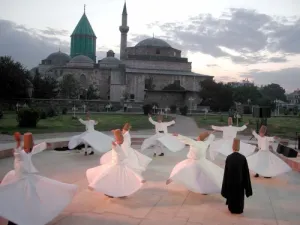
Rumi taught the path of divine love as the means to transcend the ego and realize union with the Beloved. Through poetry, music, and the whirling meditation that became the practice of his order, he pointed to love as both the path and the destination. He emphasized surrender, the burning away of the false self, and the discovery that separation from the divine was always only an illusion.
Selected quotes
“ Everything in the universe is within you. Ask all from yourself. ”
“ As you start to walk on the way, the way appears. ”
“ It's your road and yours alone. Others may walk it with you, but no one can walk it for you. ”